The Compact Fiber as the Canonical Admissibility Structure for Discrete Scalar Motion
Posted: Wed Apr 22, 2026 10:27 am
Foundational compact-fiber papers
The Compact Fiber as the Canonical Admissibility Structure for Discrete Scalar Motion ("Paper I")
The Compact Fiber as the Canonical Admissibility Structure for Discrete Scalar Motion: A Necessity Result for the Reciprocal System.
This paper derives the compact admissibility structure appropriate to the stable local material regime of discrete scalar motion. Its central claim is a necessity claim rather than a phenomenological fit claim: once the relevant closure, covering, and stability conditions of the stable local regime are imposed, the compact fiber is not a convenient model choice but the canonical admissibility structure.
The result is intended as a foundational paper for later atomic and effective-quantum developments within the stable local regime. It does not claim that all scalar-motion regimes, including earlier or less structured regimes such as radiation, must instantiate the same full compact local carrier in the same way.
Atomic Structure from the Compact Fiber: Transport, Screening, and Spectroscopic Thresholds in the Reciprocal System ("Paper II")
Atomic Structure from the Compact Fiber: Transport, Screening, and Spectroscopic Thresholds in the Reciprocal System.
This paper develops the first major physical application of the compact fiber established in the companion foundational paper. Its primary result is the Class II screening classification: all 11 screening slopes and intercepts for ionization energy, electron affinity, fine-structure splitting, and electric polarizability are generated mechanically from the compact fiber’s transport and readout geometry, with zero per-element fitted parameters.
Building on this classification, the paper develops a Class I restoration-depth law, a time-region / Kustaanheimo–Stiefel bridge recovering the hydrogen Rydberg spectrum, and a quantum-defect threshold that reproduces the periodic-table group structure. In the mature core, the framework produces about 95 atom-observable comparisons at about 5.7% weighted mean absolute error against NIST data. One global normalization constant remains open.
Effective Quantum and Gravitational Structure from the Compact Fiber: Cross-Frame Projection, Hilbert Representation, Born Rule, and Coordinate-Time Metric ("Paper III")
This paper develops an effective quantum and gravitational representational layer from the compact fiber

and its degree-2 covering map, previously derived from discrete scalar-motion postulates. It argues that core structures usually treated as primitive in standard quantum mechanics—complex amplitudes, inner product, Born-rule probabilities, effective Hilbert space, superposition, entanglement, Bell correlations, and the measurement projection structure—can instead be derived as representational consequences of the compact carrier and cross-frame projection.
The paper also develops a parallel gravitational program in which an effective coordinate-time metric is obtained from reciprocal partition of gravitational potential, reproducing the first-order PPN values

the equivalence principle, and the four classical Solar System tests, while identifying second-order departures from general relativity as empirical discriminators. The manuscript explicitly audits which ingredients are derived, which are imported mathematical tools, which are interpretive identifications, and which remain open formalization tasks.
A quantitative anchor is provided through the ⁸⁷Rb Rydberg Förster-resonance regime, where the framework reproduces the observed

interaction scaling and the reported C₃ scale to within the stated accuracy.
Radiation and finite-readout extensions
Radiation from the Compact Fiber: A Unified Architecture for Polarization, Interference, Correlation, Topology, and Radiation-Matter Transfer
Radiation from the Compact Fiber develops the radiation sector of the compact-fiber framework as a unified benchmark architecture rather than a collection of disconnected phenomenon-specific models. The paper shows how one radiation-side structural hierarchy, together with the previously established representational/readout layer, recovers a broad benchmark class including polarization, single-photon interference, Bell polarization correlation, Hong–Ou–Mandel bunching, orbital-angular structure, and the photoelectric event architecture. It also states the associated scaling bridge between recurrence-based natural content and conventional energy–frequency units.
The central claim is not that all radiation physics is completed here, but that within the stated benchmark regime, these phenomena can be recovered with fewer independent starting assumptions and greater structural continuity than in the usual compartmentalized treatments. The paper introduces a reusable radiation network calculus, derives the Bell opposed-pair state from an opposition condition rather than positing it, treats HOM bunching through explicit two-photon cancellation, derives integer angular quantization from coherent closure on a compact transverse cycle, and models photoelectric emission as a per-mode radiation–matter transfer event. Claim strength is stated explicitly throughout, with boundaries and exclusions recorded to keep the scope disciplined.
Finite Readout Representations and Matching Corrections from the Compact Fiber
This paper develops a finite readout and matching protocol for the compact fiber

The first part formalizes the compact fiber as a finite character/readout object by passing to its character group
).
)
The two ℤ₄ factors define finite magnetic character sectors, while the ℤ₈ factor defines the finite electric character sector. The degree-two cover

identifies direct magnetic-base compatibility with even electric characters and gives odd electric characters a deck-parity interpretation.
The main finite-layer result is the Character-Readout Classification Theorem. It shows that recurring compact-fiber factors such as 1/8, 1/4, 7/8, 1/32, and 128 arise as projections, complements, product-sector resolutions, or full character counts. The cover-mediated factor 1/16 is fixed once a readout is assigned to the degree-two electric cover class. The paper also proves a finite character conservation rule for closed internal finite-sector couplings and recasts the radiation-paper OAM parity rule as a cover-compatibility statement.
The second part applies the same status discipline to an elementary natural-unit mass-to-energy bridge. The bridge is represented as a single source-to-target traversal from a completed two-dimensional secondary-mass source to an energy/readout target. This fixes the typed package

Using the Larson–Nehru interregional and secondary-mass bridge-layer rules, the electric boundary contribution is reconstructed as
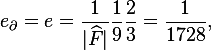
so the admissible elementary matching package is

The result is a no-retuning audit framework: a proposed factor must be a defined finite-character operation, a cover-conditional readout, a theorem-grade bridge result under stated premises, or an open term. Competing packages such as m, m + 2e + C, e − c, and e − C are rejected by readout class rather than by numerical fit.
Constants-sector papers
A Compact-Fiber Structural Prediction of the Low-Energy Electromagnetic Coupling
A Compact-Fiber Structural Prediction of the Low-Energy Electromagnetic Coupling develops a compact-fiber structural prediction for the low-energy electromagnetic bridge coupling.
The paper derives an inverse bridge capacity from the compact-fiber carrier, radiative/vibrational bridge-placement readout, cover-mediated feedback, self-consistent transport sharing, and the first closed return of the admitted feedback. The resulting quartic equation has positive root

so that
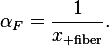
The measured fine-structure constant is not used as an algebraic input, and no continuously adjusted coefficient appears in the bridge equation. The identification of α_F with the low-energy electromagnetic coupling is made by physical role: leading atomic binding reads the material/radiative bridge through two vertices and therefore carries an α_F² dependence, matching the role of α² in the Hartree/Rydberg scale.
The numerical comparison with the empirical fine-structure constant is presented as a consistency check, not as an error-budget closure. Route-specific metrological extraction, QED vertex expansion, electrical-standard readout, and broader second-observable closure remain downstream work.
Secondary-Mass Context and the Planck and Gravitational Couplings in the Compact-Fiber Framework
Secondary-Mass Context in the Planck and Gravitational Couplings from the Compact Fiber develops a secondary-mass context rule within the compact-fiber/Larson/Nehru mass architecture.
The central result is that Planck/action conversion and gravitational mass-unit conversion require different secondary-mass corrections because they correct different structural operations. The Planck/action calculation uses the full particle secondary mass,

while the gravitational calculation uses only the gravitationally intrinsic secondary mass,

The accompanying reproducibility materials evaluate the Planck/action constant, the gravitational constant, the dimensionless proton gravitational coupling, and the four assignment-control cases. The structurally predicted assignment gives residuals of approximately −7.8 ppm for h, +160.2 ppm for G, and −32.8 ppm for
}.
)
The result is presented as a bounded constants-sector test of the secondary-mass context rule, not as an anchor-free derivation of the gravitational hierarchy or a modern SI realization of dimensional constants. The calculation uses the stated Larson-era anchor system and imports the compact-fiber carrier structure from prior compact-fiber work.
Materials and crystal-structure applications
A Fixed-Input Admissibility Rule for Cation Coordination Numbers in Extended Ionic Crystals
This paper develops and audits a fixed-input admissibility rule for cation coordination numbers in extended ionic crystals.
The rule uses a provided element-input table, fixed structural constants, and a deterministic compound-role classifier to assign an admissible integer coordination-number set to each structure-determining cation site. It is evaluated on 74,050 structure-determining cation sites across 17,947 analyzed structures spanning oxides, fluorides, chlorides, and sulfides.
The main empirical result is cross-anion transfer: the same rule maintains at least 98.2% agreement across all validation datasets without fitting constants to the validation data and without introducing anion-specific admissibility parameters. Null, shuffled, Pauling radius-ratio, ablation, per-element, sensitivity, and residual-failure audits are included to separate broad coordination-number prevalence from element-specific discriminative value.
The paper also distinguishes the primary structure-determining cation domain from passive, molecular, polyatomic-anion-center, and local-environment artifact regimes. Its status is a published compact-fiber materials application and a reproducible early-stage screening method for ionic-structure validation, anomaly detection, and generative materials workflows.
Structural Predictions of Magnetic Exchange Coupling Signs from Compact-Fiber Geometry
This paper develops a compact-fiber structural classification of magnetic exchange-coupling signs in selected local materials geometries. Starting from the finite compact-fiber carrier F ≅ Z/4Z × Z/4Z × Z/8Z, magnetic exchange pathways are treated as sector- and channel-readout problems.
The central result is a theorem-grade near-90° edge-sharing split/shared channel decomposition: the local geometry separates into a split σ channel and a shared-like π channel, carrying opposite half-filled exchange-sign tendencies. This recovers familiar Goodenough–Kanamori–Anderson sign behavior at the channel-topology level and identifies additional compact-fiber branch structure involving direct-exchange gates, magnetic-sector half-filling, bridge-Π efficiency, and mediator-pathway diagnostics.
The paper predicts and classifies exchange-coupling sign structure. It does not claim exchange magnitudes, ordering temperatures, propagation vectors, or complete magnetic phase diagrams. Empirical compounds are used as validation, boundary, and diagnostic cases for the structural readout framework.
Galactic rotation applications
Galactic Rotation from the Compact Fiber: The Gravitational Limit, R¹⁶, and a Zero-Parameter Rotation-Curve Model
This release contains the paper "Galactic Rotation from the Compact Fiber: The Gravitational Limit, R¹⁶, and a Zero-Parameter Rotation-Curve Model" and its accompanying reproducibility repository. It presents a structurally derived galactic rotation model from the compact-fiber / discrete-scalar-motion framework, together with the code, data pipeline, comparison models, scans, and analysis workflow used to generate the reported results.
The repository includes the RST nonlocal rotation-curve model, fixed-baseline MOND and DFT-B comparison models, SPARC-based evaluation across 171 galaxies, parameter and sensitivity scans, per-galaxy outputs, and scripts to reproduce the paper's headline tables and statistics from raw inputs.
The paper argues that the framework yields a specific zero-calibrated-parameter galactic rotation model with competitive performance against fixed MOND on the SPARC benchmark. This Zenodo release is intended as an open scholarly record of both the paper and the full supporting computational workflow.
Galactic Rotation from the Compact Fiber II: Structural Regime Split, Realized Coherence, and a Zero-Parameter Benchmark Improvement
This release contains the paper Galactic Rotation from the Compact Fiber II: Structural Regime Split, Realized Coherence, and a Zero-Parameter Benchmark Improvement and its accompanying reproducibility repository. It presents a second-stage compact-fiber galactic rotation model in which the original one-law formulation is extended by a structural regime split in realized galactic organization, together with the code, data pipeline, comparison models, scans, and analysis workflow used to generate the reported results.
The repository includes the frozen one-law compact-fiber baseline, the regime-split compact-fiber model, a fixed-baseline MOND comparison model, SPARC-based evaluation across 171 galaxies, threshold and transfer-family robustness scans, failure-cluster diagnostics, radial-acceleration-relation analysis, per-galaxy outputs, and scripts to reproduce the paper’s headline tables, figures, and summary statistics from raw inputs.
The paper argues that the compact-fiber framework yields a zero-calibrated-parameter regime-split galactic rotation model that improves on both the frozen one-law baseline and a fixed MOND benchmark on the SPARC sample, while also exposing a specific structural trade-off in a subset of moderate spirals. This Zenodo release is intended as an open scholarly record of both the paper and the full supporting computational workflow.
────────────────────────────────────────
The Compact Fiber in a Universe of Motion
Status note
This post is intended to explain the main line of development in a form suitable for discussion.
Status labels used here:
Some of the words used in compact-fiber work are not Larson's usual words. They are translation terms, not replacements for Larson's concepts.
Fiber-bundle representations in physics
Fiber-bundle representations are already used elsewhere in physics. In gauge theory, for example, one separates the ordinary represented space from internal degrees of freedom attached at each point. In the Hopf fibration, a circle fiber is organized over a sphere, giving a standard example of how a projection can show one level of a richer structure.
The compact fiber uses the same general representational idea in a much simpler finite form. It is not the Hopf fibration, and it is not a continuum gauge bundle. Its role is to represent the finite closure and readout structure implicit in Larson's rotational displacement system. The base/fiber language is useful because it separates what is represented in extension space from the internal finite motion-structure that gives rise to the represented quantities.
1. Larson's starting point
Larson's Reciprocal System begins with the postulate that the physical universe is composed entirely of motion. Space and time are not independent containers. They are reciprocal aspects of motion. Unit speed is the natural datum.
From this foundation Larson develops scalar progression, radiation, gravitation, atoms, the time region, and material properties. The compact-fiber work does not replace this foundation. It makes explicit a finite closure structure implicit in Larson's rotational displacement system.
2. Why a closure structure is needed
If atoms are stable combinations of scalar motion, then their rotational displacements cannot be open-ended. A stable combination must complete a finite pattern. Larson's atomic triplets already show that the two magnetic entries and the electric entry have distinct roles. The compact-fiber work asks what finite structure is required for those triplets to close.
3. How the compact fiber was found
The compact fiber was chosen because it preserves the structure already implicit in Larson's rotational displacement system. A key discovery was that Larson's atomic rotational triplets exhibit a cyclic, sinusoidal-phase-like pattern when arranged in their natural order. The magnetic and electric entries do not advance as unrelated counters. They behave like readouts of a finite internal phase structure.
This led to a bundle interpretation: the triplet is the displayed value, while an internal finite closure structure accounts for why the triplets have the pattern they do.
Candidate carriers were then constrained by three rules:

The two fourfold parts are magnetic. The eightfold part is electric. The electric part functions as a degree-2 cover over the magnetic closure scale.
4. What the compact fiber provides
The compact fiber gives the finite closure capacities:

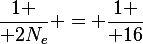
The degree-2 electric cover gives:
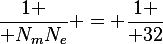
Combined magnetic-electric transport gives:
These scales are not introduced because they fit one later table. They arise from the carrier. Their importance is that they recur in independent applications.
5. Published compact-fiber results
K.V.K. Nehru identified a real problem in the way Larson's photon account could be understood. If the photon is described only as linear simple harmonic motion, it can seem too thin to support polarization, rotational content, spin-like implications, and time-region consequences.
Nehru's birotation device addressed this by treating the represented linear simple harmonic motion as the result of two equal and opposite rotational components. This preserved the linear readout while supplying underlying rotational structure.
The compact-fiber Radiation-level work absorbs this role into a broader structure. Larson's simple harmonic motion remains the first radiation-capable level. Higher levels can carry transverse aspect, orientation sign, handedness, balanced internal organization, winding structure, and other photon-side features. In this view, birotation was an important intermediate repair device, but it is not needed as a separate primitive once the level structure is available.
This addresses Nehru's concerns as follows:
Larson supplied the primary physical conception: a universe composed entirely of motion, with space and time as reciprocal aspects of motion. He also supplied scalar progression, rotational displacement notation, the magnetic/electric distinction, the time-region framework, interregional relations, and many numerical calculations.
The compact-fiber work continues that deductive program by making the finite structure behind the calculations explicit. The improvement is not a change of foundation. It is a more exact representation of the same motion-first structure.
The Compact Fiber as the Canonical Admissibility Structure for Discrete Scalar Motion ("Paper I")
The Compact Fiber as the Canonical Admissibility Structure for Discrete Scalar Motion: A Necessity Result for the Reciprocal System.
This paper derives the compact admissibility structure appropriate to the stable local material regime of discrete scalar motion. Its central claim is a necessity claim rather than a phenomenological fit claim: once the relevant closure, covering, and stability conditions of the stable local regime are imposed, the compact fiber is not a convenient model choice but the canonical admissibility structure.
The result is intended as a foundational paper for later atomic and effective-quantum developments within the stable local regime. It does not claim that all scalar-motion regimes, including earlier or less structured regimes such as radiation, must instantiate the same full compact local carrier in the same way.
Atomic Structure from the Compact Fiber: Transport, Screening, and Spectroscopic Thresholds in the Reciprocal System ("Paper II")
Atomic Structure from the Compact Fiber: Transport, Screening, and Spectroscopic Thresholds in the Reciprocal System.
This paper develops the first major physical application of the compact fiber established in the companion foundational paper. Its primary result is the Class II screening classification: all 11 screening slopes and intercepts for ionization energy, electron affinity, fine-structure splitting, and electric polarizability are generated mechanically from the compact fiber’s transport and readout geometry, with zero per-element fitted parameters.
Building on this classification, the paper develops a Class I restoration-depth law, a time-region / Kustaanheimo–Stiefel bridge recovering the hydrogen Rydberg spectrum, and a quantum-defect threshold that reproduces the periodic-table group structure. In the mature core, the framework produces about 95 atom-observable comparisons at about 5.7% weighted mean absolute error against NIST data. One global normalization constant remains open.
Effective Quantum and Gravitational Structure from the Compact Fiber: Cross-Frame Projection, Hilbert Representation, Born Rule, and Coordinate-Time Metric ("Paper III")
This paper develops an effective quantum and gravitational representational layer from the compact fiber
and its degree-2 covering map, previously derived from discrete scalar-motion postulates. It argues that core structures usually treated as primitive in standard quantum mechanics—complex amplitudes, inner product, Born-rule probabilities, effective Hilbert space, superposition, entanglement, Bell correlations, and the measurement projection structure—can instead be derived as representational consequences of the compact carrier and cross-frame projection.
The paper also develops a parallel gravitational program in which an effective coordinate-time metric is obtained from reciprocal partition of gravitational potential, reproducing the first-order PPN values
the equivalence principle, and the four classical Solar System tests, while identifying second-order departures from general relativity as empirical discriminators. The manuscript explicitly audits which ingredients are derived, which are imported mathematical tools, which are interpretive identifications, and which remain open formalization tasks.
A quantitative anchor is provided through the ⁸⁷Rb Rydberg Förster-resonance regime, where the framework reproduces the observed
interaction scaling and the reported C₃ scale to within the stated accuracy.
Radiation and finite-readout extensions
Radiation from the Compact Fiber: A Unified Architecture for Polarization, Interference, Correlation, Topology, and Radiation-Matter Transfer
Radiation from the Compact Fiber develops the radiation sector of the compact-fiber framework as a unified benchmark architecture rather than a collection of disconnected phenomenon-specific models. The paper shows how one radiation-side structural hierarchy, together with the previously established representational/readout layer, recovers a broad benchmark class including polarization, single-photon interference, Bell polarization correlation, Hong–Ou–Mandel bunching, orbital-angular structure, and the photoelectric event architecture. It also states the associated scaling bridge between recurrence-based natural content and conventional energy–frequency units.
The central claim is not that all radiation physics is completed here, but that within the stated benchmark regime, these phenomena can be recovered with fewer independent starting assumptions and greater structural continuity than in the usual compartmentalized treatments. The paper introduces a reusable radiation network calculus, derives the Bell opposed-pair state from an opposition condition rather than positing it, treats HOM bunching through explicit two-photon cancellation, derives integer angular quantization from coherent closure on a compact transverse cycle, and models photoelectric emission as a per-mode radiation–matter transfer event. Claim strength is stated explicitly throughout, with boundaries and exclusions recorded to keep the scope disciplined.
Finite Readout Representations and Matching Corrections from the Compact Fiber
This paper develops a finite readout and matching protocol for the compact fiber
The first part formalizes the compact fiber as a finite character/readout object by passing to its character group
The two ℤ₄ factors define finite magnetic character sectors, while the ℤ₈ factor defines the finite electric character sector. The degree-two cover
identifies direct magnetic-base compatibility with even electric characters and gives odd electric characters a deck-parity interpretation.
The main finite-layer result is the Character-Readout Classification Theorem. It shows that recurring compact-fiber factors such as 1/8, 1/4, 7/8, 1/32, and 128 arise as projections, complements, product-sector resolutions, or full character counts. The cover-mediated factor 1/16 is fixed once a readout is assigned to the degree-two electric cover class. The paper also proves a finite character conservation rule for closed internal finite-sector couplings and recasts the radiation-paper OAM parity rule as a cover-compatibility statement.
The second part applies the same status discipline to an elementary natural-unit mass-to-energy bridge. The bridge is represented as a single source-to-target traversal from a completed two-dimensional secondary-mass source to an energy/readout target. This fixes the typed package
Using the Larson–Nehru interregional and secondary-mass bridge-layer rules, the electric boundary contribution is reconstructed as
so the admissible elementary matching package is
The result is a no-retuning audit framework: a proposed factor must be a defined finite-character operation, a cover-conditional readout, a theorem-grade bridge result under stated premises, or an open term. Competing packages such as m, m + 2e + C, e − c, and e − C are rejected by readout class rather than by numerical fit.
Constants-sector papers
A Compact-Fiber Structural Prediction of the Low-Energy Electromagnetic Coupling
A Compact-Fiber Structural Prediction of the Low-Energy Electromagnetic Coupling develops a compact-fiber structural prediction for the low-energy electromagnetic bridge coupling.
The paper derives an inverse bridge capacity from the compact-fiber carrier, radiative/vibrational bridge-placement readout, cover-mediated feedback, self-consistent transport sharing, and the first closed return of the admitted feedback. The resulting quartic equation has positive root
so that
The measured fine-structure constant is not used as an algebraic input, and no continuously adjusted coefficient appears in the bridge equation. The identification of α_F with the low-energy electromagnetic coupling is made by physical role: leading atomic binding reads the material/radiative bridge through two vertices and therefore carries an α_F² dependence, matching the role of α² in the Hartree/Rydberg scale.
The numerical comparison with the empirical fine-structure constant is presented as a consistency check, not as an error-budget closure. Route-specific metrological extraction, QED vertex expansion, electrical-standard readout, and broader second-observable closure remain downstream work.
Secondary-Mass Context and the Planck and Gravitational Couplings in the Compact-Fiber Framework
Secondary-Mass Context in the Planck and Gravitational Couplings from the Compact Fiber develops a secondary-mass context rule within the compact-fiber/Larson/Nehru mass architecture.
The central result is that Planck/action conversion and gravitational mass-unit conversion require different secondary-mass corrections because they correct different structural operations. The Planck/action calculation uses the full particle secondary mass,
while the gravitational calculation uses only the gravitationally intrinsic secondary mass,
The accompanying reproducibility materials evaluate the Planck/action constant, the gravitational constant, the dimensionless proton gravitational coupling, and the four assignment-control cases. The structurally predicted assignment gives residuals of approximately −7.8 ppm for h, +160.2 ppm for G, and −32.8 ppm for
The result is presented as a bounded constants-sector test of the secondary-mass context rule, not as an anchor-free derivation of the gravitational hierarchy or a modern SI realization of dimensional constants. The calculation uses the stated Larson-era anchor system and imports the compact-fiber carrier structure from prior compact-fiber work.
Materials and crystal-structure applications
A Fixed-Input Admissibility Rule for Cation Coordination Numbers in Extended Ionic Crystals
This paper develops and audits a fixed-input admissibility rule for cation coordination numbers in extended ionic crystals.
The rule uses a provided element-input table, fixed structural constants, and a deterministic compound-role classifier to assign an admissible integer coordination-number set to each structure-determining cation site. It is evaluated on 74,050 structure-determining cation sites across 17,947 analyzed structures spanning oxides, fluorides, chlorides, and sulfides.
The main empirical result is cross-anion transfer: the same rule maintains at least 98.2% agreement across all validation datasets without fitting constants to the validation data and without introducing anion-specific admissibility parameters. Null, shuffled, Pauling radius-ratio, ablation, per-element, sensitivity, and residual-failure audits are included to separate broad coordination-number prevalence from element-specific discriminative value.
The paper also distinguishes the primary structure-determining cation domain from passive, molecular, polyatomic-anion-center, and local-environment artifact regimes. Its status is a published compact-fiber materials application and a reproducible early-stage screening method for ionic-structure validation, anomaly detection, and generative materials workflows.
Structural Predictions of Magnetic Exchange Coupling Signs from Compact-Fiber Geometry
This paper develops a compact-fiber structural classification of magnetic exchange-coupling signs in selected local materials geometries. Starting from the finite compact-fiber carrier F ≅ Z/4Z × Z/4Z × Z/8Z, magnetic exchange pathways are treated as sector- and channel-readout problems.
The central result is a theorem-grade near-90° edge-sharing split/shared channel decomposition: the local geometry separates into a split σ channel and a shared-like π channel, carrying opposite half-filled exchange-sign tendencies. This recovers familiar Goodenough–Kanamori–Anderson sign behavior at the channel-topology level and identifies additional compact-fiber branch structure involving direct-exchange gates, magnetic-sector half-filling, bridge-Π efficiency, and mediator-pathway diagnostics.
The paper predicts and classifies exchange-coupling sign structure. It does not claim exchange magnitudes, ordering temperatures, propagation vectors, or complete magnetic phase diagrams. Empirical compounds are used as validation, boundary, and diagnostic cases for the structural readout framework.
Galactic rotation applications
Galactic Rotation from the Compact Fiber: The Gravitational Limit, R¹⁶, and a Zero-Parameter Rotation-Curve Model
This release contains the paper "Galactic Rotation from the Compact Fiber: The Gravitational Limit, R¹⁶, and a Zero-Parameter Rotation-Curve Model" and its accompanying reproducibility repository. It presents a structurally derived galactic rotation model from the compact-fiber / discrete-scalar-motion framework, together with the code, data pipeline, comparison models, scans, and analysis workflow used to generate the reported results.
The repository includes the RST nonlocal rotation-curve model, fixed-baseline MOND and DFT-B comparison models, SPARC-based evaluation across 171 galaxies, parameter and sensitivity scans, per-galaxy outputs, and scripts to reproduce the paper's headline tables and statistics from raw inputs.
The paper argues that the framework yields a specific zero-calibrated-parameter galactic rotation model with competitive performance against fixed MOND on the SPARC benchmark. This Zenodo release is intended as an open scholarly record of both the paper and the full supporting computational workflow.
Galactic Rotation from the Compact Fiber II: Structural Regime Split, Realized Coherence, and a Zero-Parameter Benchmark Improvement
This release contains the paper Galactic Rotation from the Compact Fiber II: Structural Regime Split, Realized Coherence, and a Zero-Parameter Benchmark Improvement and its accompanying reproducibility repository. It presents a second-stage compact-fiber galactic rotation model in which the original one-law formulation is extended by a structural regime split in realized galactic organization, together with the code, data pipeline, comparison models, scans, and analysis workflow used to generate the reported results.
The repository includes the frozen one-law compact-fiber baseline, the regime-split compact-fiber model, a fixed-baseline MOND comparison model, SPARC-based evaluation across 171 galaxies, threshold and transfer-family robustness scans, failure-cluster diagnostics, radial-acceleration-relation analysis, per-galaxy outputs, and scripts to reproduce the paper’s headline tables, figures, and summary statistics from raw inputs.
The paper argues that the compact-fiber framework yields a zero-calibrated-parameter regime-split galactic rotation model that improves on both the frozen one-law baseline and a fixed MOND benchmark on the SPARC sample, while also exposing a specific structural trade-off in a subset of moderate spirals. This Zenodo release is intended as an open scholarly record of both the paper and the full supporting computational workflow.
────────────────────────────────────────
The Compact Fiber in a Universe of Motion
Status note
This post is intended to explain the main line of development in a form suitable for discussion.
Status labels used here:
- primary source — Larson's original Reciprocal System work.
- RS development source — post-Larson development, especially K.V.K. Nehru.
- published compact-fiber result — formal compact-fiber result with stable public source/DOI.
Some of the words used in compact-fiber work are not Larson's usual words. They are translation terms, not replacements for Larson's concepts.
- Projection means the represented appearance of a motion relation in extension space or in a reference-system calculation.
- Readout means the value that appears at that represented level: a triplet, threshold, finite correction, or material-distance value.
- Closure means completion of a finite displacement cycle, so that a stable motion combination can exist.
- Sector means a functional role in the displacement structure, not a spatial compartment.
- Carrier means the finite support for allowed displacement relations, not a new physical medium.
- Fiber bundle means a base level together with attached internal possibilities. Here it is finite and restricted: Larson's triplet is the displayed readout, while the compact fiber is the finite closure structure behind that readout.
Fiber-bundle representations in physics
Fiber-bundle representations are already used elsewhere in physics. In gauge theory, for example, one separates the ordinary represented space from internal degrees of freedom attached at each point. In the Hopf fibration, a circle fiber is organized over a sphere, giving a standard example of how a projection can show one level of a richer structure.
The compact fiber uses the same general representational idea in a much simpler finite form. It is not the Hopf fibration, and it is not a continuum gauge bundle. Its role is to represent the finite closure and readout structure implicit in Larson's rotational displacement system. The base/fiber language is useful because it separates what is represented in extension space from the internal finite motion-structure that gives rise to the represented quantities.
1. Larson's starting point
Larson's Reciprocal System begins with the postulate that the physical universe is composed entirely of motion. Space and time are not independent containers. They are reciprocal aspects of motion. Unit speed is the natural datum.
From this foundation Larson develops scalar progression, radiation, gravitation, atoms, the time region, and material properties. The compact-fiber work does not replace this foundation. It makes explicit a finite closure structure implicit in Larson's rotational displacement system.
2. Why a closure structure is needed
If atoms are stable combinations of scalar motion, then their rotational displacements cannot be open-ended. A stable combination must complete a finite pattern. Larson's atomic triplets already show that the two magnetic entries and the electric entry have distinct roles. The compact-fiber work asks what finite structure is required for those triplets to close.
3. How the compact fiber was found
The compact fiber was chosen because it preserves the structure already implicit in Larson's rotational displacement system. A key discovery was that Larson's atomic rotational triplets exhibit a cyclic, sinusoidal-phase-like pattern when arranged in their natural order. The magnetic and electric entries do not advance as unrelated counters. They behave like readouts of a finite internal phase structure.
This led to a bundle interpretation: the triplet is the displayed value, while an internal finite closure structure accounts for why the triplets have the pattern they do.
Candidate carriers were then constrained by three rules:
- Compactness: the carrier must be finite and closed.
- Minimality: it must not add unused sectors or extra capacities.
- Fidelity to Larson: it must preserve scalar motion, displacement, unit limits, and magnetic/electric role distinction without introducing a hidden spatial substrate.
The two fourfold parts are magnetic. The eightfold part is electric. The electric part functions as a degree-2 cover over the magnetic closure scale.
4. What the compact fiber provides
The compact fiber gives the finite closure capacities:
The degree-2 electric cover gives:
Combined magnetic-electric transport gives:
These scales are not introduced because they fit one later table. They arise from the carrier. Their importance is that they recur in independent applications.
5. Published compact-fiber results
- Atomic structure: compact-fiber transport, screening, and spectroscopic thresholds. The electric self-sector complement gives
. The
and
scales recur in finite atomic readouts. Status: published compact-fiber result.
- Quantum and gravitational readout: Hilbert representation, Born-rule-style readout, and coordinate-time metric behavior are treated as effective projections of finite compact-fiber closure. Status: published compact-fiber result.
- Cation coordination admissibility: the coordination-admissibility paper gives a fixed-input rule for screening cation coordination numbers in extended ionic crystals, achieving at least 98.2% agreement across oxide, fluoride, chloride, and sulfide validation datasets without fitted constants or anion-specific admissibility parameters. Status: published compact-fiber materials application.
- Galactic rotation: a zero-parameter compact-fiber application to SPARC Rotmod_LTG galactic rotation data. Status: published application.
- Radiation architecture: compact-fiber levels for polarization, interference, correlation, topology/winding, and radiation-matter transfer. Status: published compact-fiber result.
- Finite readout and matching corrections: the readout paper formalizes finite factors such as
,
,
,
, and gives a no-retuning status calculus for matching corrections. Status: published compact-fiber result.
- Alpha bridge coupling: the alpha paper derives
and
from compact-fiber bridge structure, without using the measured alpha value as algebraic input. Status: published compact-fiber constants result.
- Planck and gravitational couplings: the Planck/gravity paper distinguishes
for Planck/action from
for gravitational mass-unit correction, and tests the assignments against
,
, and
. Status: published compact-fiber constants result.
K.V.K. Nehru identified a real problem in the way Larson's photon account could be understood. If the photon is described only as linear simple harmonic motion, it can seem too thin to support polarization, rotational content, spin-like implications, and time-region consequences.
Nehru's birotation device addressed this by treating the represented linear simple harmonic motion as the result of two equal and opposite rotational components. This preserved the linear readout while supplying underlying rotational structure.
The compact-fiber Radiation-level work absorbs this role into a broader structure. Larson's simple harmonic motion remains the first radiation-capable level. Higher levels can carry transverse aspect, orientation sign, handedness, balanced internal organization, winding structure, and other photon-side features. In this view, birotation was an important intermediate repair device, but it is not needed as a separate primitive once the level structure is available.
This addresses Nehru's concerns as follows:
- Scalar/vector reversal coordination is handled by separating underlying scalar recurrence from represented extension-space oscillation.
- Regular reversal patterns are handled by finite closure.
- Even-frequency and non-integral-frequency issues are handled by admissible finite recurrence.
- Rotational content appears at higher photon-side levels rather than being forced into the lowest linear readout.
- Angular-momentum or spin-like concerns are handled by balanced internal organization.
- Time-region and non-locality concerns are handled through projection/readout rather than through ordinary spatial mechanism.
- Superconductivity remains connected to Nehru's time-region insight, but current compact-fiber superconductivity work remains exploratory.
Larson supplied the primary physical conception: a universe composed entirely of motion, with space and time as reciprocal aspects of motion. He also supplied scalar progression, rotational displacement notation, the magnetic/electric distinction, the time-region framework, interregional relations, and many numerical calculations.
The compact-fiber work continues that deductive program by making the finite structure behind the calculations explicit. The improvement is not a change of foundation. It is a more exact representation of the same motion-first structure.
- Atomic triplets become finite-closure readouts. Larson's atomic triplets are not merely labels in a table. When arranged in their natural order, they show a cyclic phase pattern. The compact fiber explains this pattern through fourfold magnetic closure, eightfold electric closure, and a degree-2 electric cover:
- Recurring numerical factors gain structural provenance. Factors such as
are not selected case by case. They arise as single-sector projections, complements, cover resolutions, product-sector resolutions, or full finite character counts. This is the role of the finite readout and matching paper. - Matching corrections become status-controlled. Larson and Nehru used natural-unit and interregional relations in constants and material-property calculations. The compact-fiber readout paper adds a stricter rule: classify the readout first, determine the factor second, compare with data last. A correction must be a defined finite readout, a stated bridge operation, or an open term.
- Radiation rules are recovered from one architecture. Legacy physics often introduces polarization, interference, beamsplitter phases, Bell correlations, photon bunching, and photoelectric transfer through separate formal rules. The compact-fiber Radiation work recovers the benchmark rules from one radiation architecture: branch transport, junction structure, readout-class coherence, tensor/exchange symmetry, and Born readout.
- Hund's rules are recovered as configuration admissibility. Hund's rules are usually taught as empirical ordering rules for atomic ground terms. The compact-fiber shell-admissibility work recovers the LS-coupled open-shell ordering by maximizing kernel alignment, then maximizing base spread, with the half-filled reversal supplied by pair cancellation and particle-hole complement. In the standard open
,
, and
shell benchmark set, the method reproduces all 27 cases.
- Quantum and gravitational form are treated as readouts. Hilbert-space representation, Born-rule probabilities, and coordinate-time metric behavior are not treated as primary substances or mechanisms. They are effective represented forms of finite motion-closure structure.
Quantum mechanics as a provably constructively degenerate representation
The compact-fiber work also changes the status of quantum mechanics. Quantum mechanics is not discarded. It is reclassified.
In the compact-fiber domains reconstructed so far, quantum mechanics provides a provably constructively degenerate representation of physical phenomena. By constructively degenerate, I mean that the quantum representation preserves the observable statistical and operator structure of the phenomena, but omits the underlying constructive motion structure that produces those readouts.
This is why the formalism works so well and yet remains incomplete as a physical explanation. It gives the correct projected calculus of states, operators, amplitudes, and probabilities. It does not give the finite motion structure from which those readouts arise.
The proof is supplied by reconstruction. Hilbert representation, Born readout, interference, Bell correlation, Hong-Ou-Mandel bunching, radiation-network behavior, finite readout factors, and Hund-rule ordering are recovered from compact-fiber structure and its readout rules. These are usually treated in legacy theory as formal primitives, empirical rules, or separate postulates. In the compact-fiber account they become consequences of one finite motion structure. - Constants work becomes less empirical. Larson and Nehru gave important natural-unit and interregional calculations. The compact-fiber alpha and Planck/gravity papers improve this line by deriving bridge counts, secondary-mass context, and wrong-assignment controls from finite structure rather than selecting factors only after numerical comparison.
- Large-scale rotation becomes a zero-parameter application. The galactic-rotation work shows that the compact fiber is not confined to atomic or radiation phenomena. It gives a structural account of galaxy rotation behavior on the SPARC benchmark without fitting a phenomenological parameter to each galaxy.