DFT-13: Relativistic Effects as Projection Geometry
Posted: Wed Dec 03, 2025 4:51 pm
DFT-13: Relativistic Effects as Projection Geometry — Why Lorentz Factors, Redshifts, and Precession Require No New Postulates
In the previous post (DFT-12), we saw how familiar RS concepts—mass, momentum, and energy—arise once a fixed scalar increment must be shared between S-frame translation and T-frame winding. Here we show that the geometry of that sharing automatically produces the “relativistic” effects, without postulating spacetime curvature or Lorentz transformations.
The objective is not to deny relativity.
Relativity is correct as a description.
DFT simply shows why relativity has the mathematical form it does — because it is the S-frame descriptive layer of the deeper scalar projection geometry.
This is the first post where the S/T distinction really pays off quantitatively. We will see:
Only a deeper interpretation of the same empirical content.
1. The Origin of the Lorentz Factor
The projection constraint (DFT-10):

In RS natural units, the scalar increment equals the intrinsic parameter step:

If an object moves with speed 𝑣 in the S-frame:

(Here this defines the S-frame speed as the projection increment per scalar increment; it is not an additional postulate.)
Thus:

The observable clock rate (proper-time increment) is:

where Δt arises from Δλ under S-frame projection, and here c=1 by choice of natural RS units.
The dimensional scale relating RS units to SI (including the appearance of 𝑐) will be introduced explicitly in a later post.
For now, this affects only numerical scale, not geometric form.
The Lorentz factor is therefore:
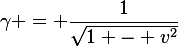
Derived, not postulated.
2. Time Dilation as T-Frame Suppression
In relativity textbooks, time “slows down.”
In DFT, nothing slows — the T-frame participates less.
As 𝑣 increases:
∣Δ𝑥∣ increases,
the projection constraint forces ∣Δ𝜃∣ to decrease.
So the clock rate is reduced because less scalar motion is available for T-frame winding.
RS called this “exceeding unity” partially converting space into time.
DFT expresses the same mechanism through projection geometry.
No metaphysics of time changing is required.
3. Gravitational Redshift from Rotational Curvature
In DFT-11 we established:
Inward motion in the S-frame ↔ increased T-frame rotation.
Let the rotational contribution be:
^{2})
Then:
^{2} - n^{2}(\Delta \lambda)^{2}
= (1 - n^{2})(\Delta \lambda)^{2})
Interpretation:
})
in the weak-field limit, reproducing the standard redshift formula.
Thus gravitational redshift follows from budget allocation under projection — not curved spacetime.
4. Perihelion Advance as Accumulated T-Frame Curvature
Nehru’s result:
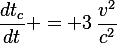
Each unit of independent motion contributes T-frame structure.
Over an orbit, this accumulated curvature forces a slight S-frame adjustment, producing precession.
In DFT: rotational curvature affects the projection budget.
The imbalance manifests as perihelion advance.
Nehru’s weak-field evaluation reproduces the observed:

for Mercury.
A short quantitative note will be provided separately.
The factor “3” arises (DFT-6) because curvature increases along three orthogonal temporal axes.
5. Energy–Momentum Relation as a Rewrite of Projection
Let:

Projection demands:

In natural units where:

we have:

Interpreting:

In SI units this corresponds to:
^{2} + (mc^{2})^{2})
Here we use 𝑐=1 because we are working in the intrinsic RS unit system; the dimensional mapping to SI is introduced later.
Thus the relativistic energy–momentum relation is nothing more than projection consistency.
6. Summary of DFT-13
This post has shown how the standard relativistic relations emerge inevitably from projection geometry:
The appearance of Planck’s constant ℏ will emerge in DFT-19 through DFT-21, when winding quantization is introduced.
The fine-structure constant 𝛼 appears naturally in DFT-20, when cross-projection between rotation and translation is quantified.
The mechanisms are now visible.
The numerical constants come later.
In the previous post (DFT-12), we saw how familiar RS concepts—mass, momentum, and energy—arise once a fixed scalar increment must be shared between S-frame translation and T-frame winding. Here we show that the geometry of that sharing automatically produces the “relativistic” effects, without postulating spacetime curvature or Lorentz transformations.
The objective is not to deny relativity.
Relativity is correct as a description.
DFT simply shows why relativity has the mathematical form it does — because it is the S-frame descriptive layer of the deeper scalar projection geometry.
This is the first post where the S/T distinction really pays off quantitatively. We will see:
- The Lorentz factor follows from partitioning scalar motion.
- Time dilation arises from reduced T-frame participation when 𝑣 grows.
- Gravitational redshift comes from curvature consuming T-frame budget.
- Perihelion advance is accumulated curvature seen under projection.
- The energy–momentum relation is simply the projection equation.
Only a deeper interpretation of the same empirical content.
1. The Origin of the Lorentz Factor
The projection constraint (DFT-10):
In RS natural units, the scalar increment equals the intrinsic parameter step:
If an object moves with speed 𝑣 in the S-frame:
(Here this defines the S-frame speed as the projection increment per scalar increment; it is not an additional postulate.)
Thus:
The observable clock rate (proper-time increment) is:
where Δt arises from Δλ under S-frame projection, and here c=1 by choice of natural RS units.
The dimensional scale relating RS units to SI (including the appearance of 𝑐) will be introduced explicitly in a later post.
For now, this affects only numerical scale, not geometric form.
The Lorentz factor is therefore:
Derived, not postulated.
2. Time Dilation as T-Frame Suppression
In relativity textbooks, time “slows down.”
In DFT, nothing slows — the T-frame participates less.
As 𝑣 increases:
∣Δ𝑥∣ increases,
the projection constraint forces ∣Δ𝜃∣ to decrease.
So the clock rate is reduced because less scalar motion is available for T-frame winding.
RS called this “exceeding unity” partially converting space into time.
DFT expresses the same mechanism through projection geometry.
No metaphysics of time changing is required.
3. Gravitational Redshift from Rotational Curvature
In DFT-11 we established:
Inward motion in the S-frame ↔ increased T-frame rotation.
Let the rotational contribution be:
Then:
Interpretation:
- Larger 𝑛 (deeper potential) → less outward component → lower frequency observed → redshift.
- Smaller 𝑛 (higher altitude) → more outward component → higher frequency → blueshift.
in the weak-field limit, reproducing the standard redshift formula.
Thus gravitational redshift follows from budget allocation under projection — not curved spacetime.
4. Perihelion Advance as Accumulated T-Frame Curvature
Nehru’s result:
Each unit of independent motion contributes T-frame structure.
Over an orbit, this accumulated curvature forces a slight S-frame adjustment, producing precession.
In DFT: rotational curvature affects the projection budget.
The imbalance manifests as perihelion advance.
Nehru’s weak-field evaluation reproduces the observed:
for Mercury.
A short quantitative note will be provided separately.
The factor “3” arises (DFT-6) because curvature increases along three orthogonal temporal axes.
5. Energy–Momentum Relation as a Rewrite of Projection
Let:
Projection demands:
In natural units where:
we have:
Interpreting:
- 𝐾 as the S-frame kinetic/momentum contribution,
- 𝑈 as the T-frame stored rotational contribution (rest-energy),
In SI units this corresponds to:
Here we use 𝑐=1 because we are working in the intrinsic RS unit system; the dimensional mapping to SI is introduced later.
Thus the relativistic energy–momentum relation is nothing more than projection consistency.
6. Summary of DFT-13
This post has shown how the standard relativistic relations emerge inevitably from projection geometry:
- Lorentz factor: T-frame share of scalar budget.
- Time dilation: T-frame suppression as velocity rises.
- Gravitational redshift: curvature consuming T-frame participation.
- Perihelion advance: accumulated curvature modifying projection.
- Energy–momentum: algebraic form of projection consistency.
The appearance of Planck’s constant ℏ will emerge in DFT-19 through DFT-21, when winding quantization is introduced.
The fine-structure constant 𝛼 appears naturally in DFT-20, when cross-projection between rotation and translation is quantified.
The mechanisms are now visible.
The numerical constants come later.